Pages

Showing posts with label Spinoza. Show all posts

Sunday, 22 December 2024

Disturbance


However, as it generally happens that those, who have had many experiences, vacillate, so long as they regard a thing as future or past, and are usually in doubt about its issue (II. xliv. note); it follows that the emotions which arise from similar images of things are not so constant, but are generally disturbed by the images of other things, until men become assured of the issue.

Baruch Spinoza – Ethics (1677)


As Spinoza said, shifting from one viewpoint to another counts as a disturbance and we don’t generally seek this kind of disturbance. It’s a barrier to change, a hill we would have to climb to see what’s on the other side.

This brings out an aspect of the term ‘confirmation bias’, because we don’t necessarily seek the confirmation. Sometimes we do, mostly we don’t, because seeking confirmation might be disturbing. In the main it’s just bias, protection against disturbance and the online world suggests it can be pretty crude protection.

This is what mainstream media cater for, not only bias but the underlying protection against disturbance. They even make conspicuous and repeated use of the word ‘disturbing’, as do politicians. Bias is the outcome, the behaviour we see, while the remarkably powerful spectre of disturbance is what keeps the bias in place. News stories which might be disturbing are presented as windows on a disturbing world, confirmation that a particular media comfort zone is the right comfort zone.

Apart from confounding factors such as vested interests, this issue of disturbance seems to account for the slow pace in which absurd public narratives are corrected. It can take generations or even centuries to correct even the most abject stupidity. Belief in witchcraft is a historical example, catastrophic climate change a modern one.

Sunday, 12 November 2023

We are on our own


Now that we know what knowledge is necessary to us, we must describe the way and method in which we must know with this knowledge the things that are to be known. To do this, the first thing to be considered is that this inquiry must not be one stretching back to infinity: I mean to say that in order to find the best method of investigating what is true, we must not stand in need of another method to investigate this method of investigating, nor in need of a third one to investigate the second, and so on to infinity. For by such a method we can never arrive at a knowledge of what is true, nor any knowledge whatever.

Baruch Spinoza - On the Correction of the Understanding (1667)


In Spinoza's sense we are on our own with whatever seems to work as our personal criterion of worthwhile knowledge. Usually this means agreeing with or tentatively accepting a consensus which seems to work in a way we recognise as working. Often not even that.

Yet even limited personal autonomy requires us to grasp and question some of the social agreements we make when it comes to what we think we know. Why were we told it? Why are we assumed to believe it? Who gains? When we ask these questions we are striking out on our own, so the easier thing to do is don't ask them. That way we don't even know that we could ask them.

Yet without such questions there isn’t even limited personal autonomy.

Tuesday, 6 April 2021

Turning down the static


Ages ago, commenter Sam Vega was kind enough to suggest I could write a book gathering together some of the more serious themes in this blog. As yet there is no book, so to explain why I have a story to tell, but first here is the key to the problem.

In the ebb and flow of human affairs absolutely nothing ever happens twice.

Now the story.

A couple of decades ago I began to hammer out a book about the seventeenth century Dutch philosopher Baruch Spinoza. My idea was to weave Spinoza’s philosophy into the fabric of modern life, drawing lessons from his work which could be applied today. After several hundred hours of effort I finished the book but kept it to myself. I didn’t even try it out on Kindle.

I'd enjoyed writing it anyway, but there was a problem – the evolution of ideas. A worthwhile personal philosophy evolves too quickly to be written down in a satisfactory way because nothing ever happens twice. We do not even have the same idea twice. This sounds odd because we have a powerful sense of an enduring self, coupled with an enduring set of ideas - as Spinoza certainly had. Yet suppose we consider a fairly common event such as a political scandal.

Any political scandal is likely to stimulate familiar ideas about more general political failings, as we know too well. Yet the latest political scandal is never exactly the same as any previous scandal nor will it be identical to any subsequent scandal. Even political scandals evolve with the times. However familiar a scandal may be, in some respects it will always be new and therefore unique.

In other words the fabric of our lives does evolve and there is no going back to square one without losing something important – the unceasing dynamism of real life. A personal philosophy undergoes subtle adjustments whenever we encounter anything even slightly new and every event is new in some respect. It may introduce new insights, new phrases or yet another sentimental appeal to be scorned, but some aspect of the event will make it unique.

As I wrote my book I came to realise what I should have known in the first place. A personal philosophy has to evolve, otherwise it becomes a matrix of doctrines and that was not what I intended to write. The dynamic nature of real life can be ignored, but if it is ignored so is real life.

A worthwhile personal philosophy is an evolving aptitude which never ceases to evolve with surprising rapidity. In the age of the internet it may evolve on a daily basis. It may evolve between the beginning and end of a piece of writing, a lecture, a book or a video. Or a blog post. We are shallow and adaptive because we need to be. Pretend to be deep and it doesn’t work – we end up with narrow rather than deep. It is better to stay in the shallow end and evolve.

Take blogging for example. Your comments change any blog post I might choose to write, extending it into other areas from a joke to a disagreement to an aspect not covered by the post. Should you choose to add a comment to this post it will alter it but here’s the interesting aspect – it will alter me as I read the comment. Writing my Spinoza book changed me, reading and editing it changed me again. In the end I didn’t want to take the book any further – I preferred to absorb the lessons of writing it and move on. I realised that I enjoy the dynamism of moving on.

A blog post is not as dynamic as a debate but less static than a book and for me that is the core problem. Turning old blog posts into a book would lose the dynamic aspect of blogging. Maybe one day I’ll do it, but as yet - no book.

Saturday, 27 February 2021

Spiderman doesn’t make sense but…


Popular culture brings us into close contact with all manner of scenarios which make no sense. Movies are full of them, from Spiderman to virtually all action movies, but what about scenarios outside popular culture? Climate change for example?

We could easily show how the orthodox climate narrative has been dragged into popular culture - it is more likely to be promoted by celebrities and pundits than scientists. Which is odd unless we assume that the point of dragging it into popular culture is to disguise the possibility that catastrophic climate scenarios do not make sense.

This is not quite the same as claiming that the science behind climate change scenarios is faulty, uncertain or unreliable. It a suggestion that the orthodox climate narrative does not make sense in much the same way that Spiderman does not make sense.

Suppose we look at it in a familiar enough way. We know that weather forecast reliability does not stretch much further than five days, yet climate forecasts are made for thirty years hence. It is easy enough to see that this may not make sense, just as Spiderman could not possibly eject an endless quantity of super strong, incredibly sticky webs from his wrists.

We easily imagine numerous scenarios which make no sense but we generally know them to be imaginary, just as Spiderman is imaginary. It’s a question of context, but manipulate the context for climate change and many people appear to be deceived. As if the familiar celebrity context mingled with a scientific context has allowed senseless imaginary scenarios to seem legitimate. As if the boundaries where we suspend our disbelief and where we don't have been blurred.

The problem is one Baruch Spinoza identified over three and a half centuries ago. We have a powerful ability to imagine scenarios which could not possibly be real. They violate natural laws, the facts of experience or both. Climate forecasting on a thirty year timescale is one of them.

Similarly one of the first political developments in the UK coronavirus debacle was to blur the line between celebrity and scientist by inviting scientists onto the stage. Drama and celebrity scientists were quickly woven into the overall narrative. Presumably for a reason.

Again we were confronted with imaginary pandemic scenarios we now know to have been dramatically exaggerated and based on inept epidemiological models. Maybe this comparison can be pushed too far, but it has a curious similarity with climate doom predictions. The context has been manipulated in a similar manner.

Sunday, 1 March 2020

You know what freedom means


“You know what freedom means.” But did he? Or, if he knew, had he got it? No, he had not got it. He had had it possibly once, but now it had been stolen from him — stolen from him by Bigges, who was pouring out champagne, stolen by the beautiful saddle of mutton, the currant jelly, the crackling brown potatoes — stolen from him by the cheque-book in his dressing-room table, the roses in the flower bowl, and the electric wires that ran behind the boarding.

Hugh Walpole - Hans Frost (1929)

Freedom is a rum idea isn’t it? Whatever it is I don’t think many people want it which at first sight seems an odd claim to put forward. Yet suppose freedom is essentially the freedom to understand. In addition, suppose that for many people it is possible to understand too much. This is one of the great historical criticisms of the middle class – they don’t understand if it doesn’t suit them to understand. It is genuine too - they really don't understand. Or rather some do but that's a different issue. And as the world becomes more and more middle class, perhaps this is a formidable flock of chickens finally coming home to roost.

For example, simple observation suggests that many folk have no wish to understand aspects of their own ethos, especially fashionable aspects which are supposed to be swallowed whole. Perhaps this still seems odd as an angle on freedom, but it appears to work rather well. It fits well with censorship, attacks on free speech, forbidden language and political attempts to hide, confuse and misdirect. All of these are attacks on our freedom to understand.

Yet when we add up the constraints of daily life as Walpole’s character does, it is easy to conclude that we have no real freedom anyway. On the other hand, the fact that we are able to think along these lines suggest that potentially we do have freedom because we understand how we could have behaved differently and the social effects of doing so.

Walpole's character knew that the beautiful saddle of mutton, the currant jelly, the crackling brown potatoes were trivial indicators of much wider constraints on his freedom. Merely rejecting the currant jelly wouldn't count for much when it came to wider questions of his freedom to think and act.

Even so, freedom still seems to be a matter of paying close attention to our options and choices instead of freewheeling all the time. We have to freewheel some of the time, perhaps most of the time, but not all the time.

This is Spinoza’s key point about understanding things as they are including our own role in things as they are. Not things as they ought to be but things as they are. Observe and understand what is going on, be truthful about it at least to ourselves and be content with that. In this way we may come to understand how and where we could have responded differently even when we didn’t. We may even understand why we didn't.

To my mind this is the great political divide, the one which cannot be bridged. There are those who try to understand themselves and their interactions with the real world and those who merely try to justify themselves. One leads to freedom and the other doesn’t. This seems to be why woke politics, the politics of political correctness is so bleak, repressive and totalitarian.

A diffuse divide as always, but still a divide. There are people who don’t want freedom and don’t want anyone else to have it either. They know they can reject the currant jelly and that seems to be enough. It's as far as they choose to go.

Monday, 18 July 2016

A kingdom within a kingdom


Most who have written on the emotions, the manner of human life, seem to have dealt not with natural things which follow the general laws of nature, but with things which are outside the sphere of nature: they seem to have conceived man in nature as a kingdom within a kingdom. For they believe that man disturbs rather than follows the course of nature, and that he has absolute power in his actions, and is not determined in them by anything else than himself. They attribute the cause of human weakness and inconstancy not to the ordinary power of nature, but to some defect or other in human nature, wherefore they deplore, ridicule despise, or, what is most common of all,  abuse it: and he that can carp in the most eloquent or acute manner at the weakness of the human mind is beheld by his fellows as almost divine.

Baruch Spinoza – Ethics (1677)

Monday, 3 August 2015

A thing

source

Sir Frederick Pollock was an interesting cove. From Wikipedia

Sir Frederick Pollock, 3rd Baronet PC was an English jurist best known for his History of English Law before the Time of Edward I, written with F.W. Maitland, and his lifelong correspondence with US Supreme Court Justice Oliver Wendell Holmes. He was a Cambridge Apostle...

...Together with his younger brother Walter Herries Pollock, he participated in the first English revival of historical fencing, originated by Alfred Hutton and his colleagues Egerton Castle, Captain Carl Thimm, Colonel Cyril Matthey, Captain Percy Rolt, Captain Ernest George Stenson Cooke, Captain Frank Herbert Whittow.


A man from a vanished era. 

Sir Frederick also found time to write book on the seventeenth century philosopher Baruch Spinoza. As one would expect, the book is thorough, erudite and much of it based on Pollock's personal perusal of original Latin texts rather than translations which he tended to distrust. The result is a formidable yet quite readable book with a number of interesting observations such as:-

A thing is a group of phenomena which persists. Herein is its individuality, its title to be counted apart from the surrounding medium.
Sir Frederick Pollock – Spinoza, His Life and Philosophy (1880)

This is Pollock’s modern take on an idea of Spinoza’s. Strict materialism doesn’t work because as Pollock says, a thing must have persistence to be counted as a thing. It must be a group of phenomena which persists. Otherwise it is no thing – nothing. If we take the material universe and try to purify it of all that is not material, if we try to shake out all the abstractions, then we run into difficulties.

The most ephemeral fundamental particle must have persistence to count as real, even if it only exists for a zillionth of a second. Otherwise it is merely theoretical and not quite real. In this sense, persistence seems to be as fundamental as physical reality without itself being physically real.

One could see it as one aspect of the problem of being both an observer and part of what is observed. We have to use abstractions, but we are part of the universe so the abstractions are too. We are in the universe and the universe is in us and we cannot stand to one side because there is nowhere to stand.

Thursday, 29 January 2015

Withheld assent

...experience seems to teach us especially clearly, that we are able to suspend our judgment before assenting to things which we perceive ; this is confirmed by the fact that no one is said to be deceived, in so far as he perceives anything, but only in so far as he assents or dissents.
Baruch Spinoza - Ethics

Karl Friston thinks our brains are wired to seek a state of fewest surprises. It’s a least action idea where the brain does as little work as possible while processing sensory data.

In short, we sample the world to ensure our predictions become a self-fulfilling prophecy and surprises are avoided. In this view, perception is enslaved by action to provide veridical predictions (more formally, to make the freeenergy a tight bound on surprise) that guides active sampling of the sensorium. 
Karl Friston

It seems to me that Friston’s idea works well enough, but doesn’t explain why some people are inclined towards scepticism, the awkward squad who see no merit in following the consensus merely because it is the consensus. Social pressure tends to create situations where not following a consensus surely requires more brainwork than following it. So what drives scepticism?

Suppose some people see fewer surprises outside a particular consensus. Or suppose they see fewer surprises in simply withholding their assent because the consensus seems flaky. If so, then there may be brainwork benefits to withheld assent even if the majority don't see it.

As an aside - maybe the majority do see the benefits of withheld assent. Maybe it is mostly the chattering classes who assent too readily to fashionable consensus. As this isn't the least action approach their brains overheat.

Withheld assent feels similar to detachment if we see detachment as perpetually withheld assent. We've known about detachment for centuries - where some people seem to prefer to remain outside the easy brainwork of consensus. 

Detachment or perpetually withheld assent may lead to fewer surprises anyway, especially in areas which are so complex that a number of interpretations always seem to be viable. Until they go wrong that is.

All of which seems to fit modern life quite well.

Friday, 12 December 2014

2015

source


For the sake of something which no one loves, strife never arises, there is no pain if it perishes, no envy if it is possessed by someone else, nor fear, nor hatred, and, to put it all briefly, no commotions of the mind at all.

Baruch Spinoza - Tractatus de Intellectus Emendatione (1677)

Thursday, 20 November 2014

The Creed

Everyone should be free to choose for himself the foundations of his creed.
Baruch Spinoza - Tractatus Theologico-Politicus

Nice try Baruch old fruit, but we should be so lucky.

Political correctness, cultural ambiguities, middle class anxieties and an abundance of stupidity seem to have evolved into what looks like a global creed. We see its fingerprints all over the current obsession with fanatically detailed social control, so let us see where the notion takes us. First we have to give the Creed more width and depth than we see in political correctness. 

To begin with we need not assume that the Creed was designed by some evil cabal of international fixers. Once it had enough momentum, then moral stupidity and political cupidity were enough to make it fly. All it required was an endless supply of nudges from inadequate politicians and our willingness to be nudged. Willingness in the sense of crowding together with regular prods to keep us mooing along in the right direction.

So the Creed is merely an outcome of our prosperous silliness, cultural weaknesses and feeble political ambivalence. It revels in those weirdly sentimental pretensions to ethical integrity we see in the so-called liberal media. The BBC and the Guardian for example.

Creed angst – you are destroying the planet.
Creed angst - the rich and powerful will do bad things.
Creed angst – something must be done.
Creed sloth – something must be done.
Creed economics – tax the rich.
Creed equality – tax the rich.
Creed philosophy – what’s your label?
Creed politics – what’s your label?
Creed religion – what’s your label?
Creed diversity – the One Creed is the Only Creed.

And so on. Essentially the Creed appears to be an evolved form of global socialism with a pervasive sentimental fuzziness woven into every thread of its fabric. It has no formal structure because it doesn’t need one. Now it has taken root it simply spews out more and more laws, regulations, treaties and those sanctimonious nudges providing constant reassurance that Something Will Always Be Done.

Equally important is the rise of an ugly and vindictive hostility directed at non-Creed folk. The threat is real - the Creed is ferociously anti-intellectual. The endlessly subtle malice of ostracism and low-key malice are directed at anyone who is openly non-Creed. This is a powerful feature – everyone is free to be as sanctimoniously malicious towards infidels as they wish.

The Creed is promoted by the EU, the UN, a vast array of charities and tax-funded pressure groups as well as traditional political parties of the left or right although it tends leans heavily to the left. As with Freudian psychoanalysis, Creed memes and narratives are aimed at acolytes only. The opinions of outside critics are irrelevant, usually attributed to their aberrant non-Creed psychology.

As the Creed is globally promoted and backed by colossal political and financial clout, its memes, narratives and prohibitions will be a dominant feature of our lives for decades at least. Forever in practical terms.

We can’t ignore it and Creed imbecilities still have to be trashed. But it is rather like standing at the door arguing with Jehovah’s Witnesses. Sooner or later it is time to close the door and put the kettle on. There are better things to do, fragments of integrity to gather in and nurture against a long Creed winter.

Friday, 17 October 2014

Knowing

Suppose many orthodox social and political narratives are either completely false or far more inaccurate than we have hitherto supposed. It’s not much of a supposition, but I’m thinking of narratives based on old-fashioned generalisations about human behaviour.

From similar causes have arisen those notions which are called universal or general, such as man, dog, horse, etc. I mean so many images arise in the human body, e.g., so many images of men are formed at the same time, that they overcome the power of imagining, not altogether indeed, but to such an extent that the mind cannot imagine the small differences between individuals (eg colour, size etc.) and their fixed number, and only that in which all agree in so far as the body is affected by them is distinctly imagined.
Baruch Spinoza - Ethics (Boyle translation)

We are all familiar with the weaknesses of what Spinoza called universal or general notions. As he says, they are substitutes for a level of individual detail we cannot possibly attain. We have to use generalisations, clambering around their many pitfalls as best we can.

Yet modern search engines and databases have already acquired a level of individual detail about many aspects of our lives and habits. They have moved on from the ancient and intractable situation where the mind cannot imagine the small differences between individuals.

So Spinoza's point is being made obsolete by technology, by huge modern databases which are not constrained by our ancient need to generalise. Not surprisingly their information is valuable enough to be sold to third parties. With safeguards it is said, but who believes that?

So generalisations are no longer necessary for those with deep pockets. We know it of course, but how do we deal with it?

How might we acquire such information ourselves without a government’s ability to twist arms? The short answer is that we can’t. The information isn’t likely to appear in books either because there is too much of it and the financial return would be inadequate. Neither is it likely to appear in academic literature for the same reasons.

So for global corporations and presumably governments, Spinoza’s problem is rapidly becoming outdated. The big hitters don’t need his universal or general notions. They have at their fingertips a colossally detailed corpus of information about human behaviour which lies well beyond the reach of most ordinary folk.

What do they know that we don’t?

How to manipulate our behaviour in order to ensure bovine social and political attitudes? Almost certainly, so the only political answer is smarter voting.

Oh oh – not smarter voting again. Rats.

Tuesday, 30 September 2014

The Freud Files

From Wikipedia

I’m tempted to buy a book called The Freud Files. It claims that Sigmund Freud promoted his own reputation, deliberately placing himself at the centre of a "lone genius" myth at the expense of others in his field. Furthermore, the book claims Freud’s acolytes have promoted and nurtured the myth for decades.

How did psychoanalysis attain its prominent cultural position? How did it eclipse rival psychologies and psychotherapies, such that it became natural to bracket Freud with Copernicus and Darwin? Why did Freud 'triumph' to such a degree that we hardly remember his rivals? This book reconstructs the early controversies around psychoanalysis and shows that rather than demonstrating its superiority, Freud and his followers rescripted history.

I suppose many of us have encountered significant cracks in Freud’s faded reputation during the course of our general reading. Doesn’t necessarily mean the issue is worth pursuing though. The field of Freudian scholarship is so vast that a dabbler is almost obliged to begin from a potentially biased starting position. Otherwise how does one select sources? Even neutrality doesn’t work if one side of this debate is substantially correct.

So as a taster I downloaded a free sample of The Freud Files onto my Kindle. You may or may not know, but this is a standard Kindle feature – browse before you buy. The book appears to be clear, concise, well-written and meticulously researched.

So if I buy it, this may be my biased starting point or it may not. Reviews suggest the book is certainly controversial and I am in no position to resolve the controversy.

However I already have a suspicion that Freud was dodgy. For example, some years ago I came across an essay in Speculum Spinozanum which claimed that he acknowledged an intellectual debt to Baruch Spinoza, the seventeenth century philosopher but only in three private letters. He never acknowledged it publicly.

This is not necessarily a big deal because Freud could not have owed a huge debt to Spinoza in the first place. Why not acknowledge it more publicly though? It would have attached an interesting thread to Freud’s thinking, locating it in the wider sphere of human thought.

Inevitably his failure to acknowledge Spinoza, however trivial his debt might have been, raises a suspicion that Freud had no wish to extend the public perception of his ideas beyond his own person. Only a suspicion, but there have been others and they add up.

Freud's reputation probably isn't particularly important to the modern world, but I was brought up in a time where he was still a towering intellectual figure, at least in popular culture. A paradigm of the "lone genius" myth. So maybe I’ll buy the book and perhaps bury the myth.

Monday, 28 April 2014

It’s the philosophy, stupid...

...but with apologies for the snowclone.

Science is a philosophy – natural philosophy. As such it is in permanent conflict with older doctrinal philosophies – the conceptual swamps where religion and politics ply their trades.

To my mind it is unfortunate that the terms natural philosophy and natural philosopher were sidelined in favour of science and scientist in the nineteenth century because the essential philosophical basis of science is apt to be forgotten.

As a result, too many scientists come across as poor philosophers, not seeming to understand clearly enough why effective science cannot have the same philosophical outlook as politics or religion. They seem to know that natural philosophy works but do not explicitly link its practical success to its non-doctrinal approach. 

For example, Baruch pinoza was an early natural philosopher, although he is now classed as a philosopher not a scientist. Yet I doubt if Spinoza would have accepted the distinction. He was a lens-grinder by trade, with a keen interest in the rapidly growing field of scientific optics. He also carried out experiments such as the hydrostatics experiment he illustrated in a letter to his friend Jarig Jelles. He was a natural philosopher.

From Spinoza’s letter to Jarig Jelles, September 1669

The distinction between science and philosophy seems to have led us into a situation where too many people confuse, mingle and otherwise conflate doctrinal philosophies with natural philosophy. They seek to bolster their scientific ideas with doctrinal authority even though scientific success obviously requires a non-doctrinal approach.

In my view this is why CAGW (catastrophic anthropogenic global warming) seems so similar to religion or politics. Why the science seems so weak and disjointed when set against its confidently catastrophic claims. The similarity arises because CAGW is a doctrinal philosophy - not natural philosophy.

Again this is why official climate change doctrine is virtually immune to the observed complexities of climate behaviour and and the failure of climate phenomena to occur as predicted. The issue is one of authority, not natural philosophy. So the public domain is dominated by doctrinal quotes, often repeated verbatim by the faithful:-

Peer review...
97% of scientists...
The Royal Society...
The vast majority of scientific papers...
The latest computer models...

Journalists, CAGW activists and too many professional scientists understand doctrinal philosophies rather better than they understand natural philosophy. They understand authority and power. They see the world through the presumed authority of their sources, not the non-doctrinal uncertainties of natural philosophy.

Certainly it is clear to me after reading too many sterile reams of CAGW text that the binding climate change rationale is a doctrinal philosophy, a search for authority rather than non-doctrinal natural philosophy.

Of course science uses doctrinal authority for well-established theories and for educational purposes, but institutions such as the Royal Society seem to have imbibed the trappings of authority too well. Awarding Nobel Prizes is well-meaning no doubt, but is it a good idea to confer doctrinal authority on natural philosophers in this way? I’m not sure that it is.

I suppose the status of natural philosophy as a successful and prestigious knowledge culture was bound to attract those with an authoritarian bent. As soon as it became conspicuously successful, it was probably doomed as a philosophy of knowledge. Political exigencies insinuated a kind of mission creep which has been going on for decades – possibly longer.

So maybe it should have come as no surprise that scientific wings are being clipped by global authoritarians of which CAGW is a major exemplar.

We are not speaking of rational versus irrational here, but of different philosophies of what constitutes rational behaviour. 

A bow to power or a bow to nature.

Thursday, 27 February 2014

That double-faced companion

Above all things he feared imagination, that double-faced companion, friend on one side and foe on the other – friend in so far as one distrusts it, and enemy if one goes trustfully to sleep to the sound of its sweet murmur.
Ivan Goncharov – Oblamov

Spinoza distrusted imagination, seeing it as the primary form of defective and deceptive thinking. However, both his view and Goncharov’s may have been influenced by the absurdly superstitious worlds in which they found themselves.

These days we value our imagination, often equating it to creativity. Yet I think Spinoza and Goncharov had a point and we should distrust its sweet murmur. It seems to me that vast swathes of political reasoning are little more than the sweet murmur of imagination swirling around some more or less nebulous utopian core.

Impossibilities dressed up as possibilities, like a dream where we swoop and soar through fluffy clouds supported by nothing better than the power of the unconscious mind to pooh pooh physics.

One day there will be an app for people who hanker after a more active imagination. An app which knows our habits and limitations will trawl the web to find some imaginative yet personalised possibilities complete with bespoke ads and special offers...

...and that’s enough imagination for one day.

Wednesday, 19 February 2014

The tool-maker

Men at first made use of the instruments supplied by nature to accomplish very easy pieces of workmanship, laboriously and imperfectly, and then, when these were finished, wrought other things more difficult with less labour and greater perfection; and so gradually mounted from the simplest operations to the making of tools, and from the making of tools to the making of more complex tools, and fresh feats of workmanship, till they arrived at making, complicated mechanisms which they now possess.

 So, in like manner, the intellect, by its native strength, makes for itself intellectual instruments, whereby it acquires strength for performing other intellectual operations, and from these operations again fresh instruments, or the power of pushing its investigations further, and thus gradually proceeds till it reaches the summit of wisdom.

Benedict Spinoza – On the Correction of the Understanding (1662)

To my mind, Spinoza’s analogy is a powerful one. In fact I’d go further and suggest that all we really do with our supposed intelligence is hone our tool-making skills. Particularly if we allow Spinoza’s point about abstract tools – the intellectual instruments he refers to.

I suppose language is the primary intellectual tool, but how do we know we are making the best use of it? Maybe it’s the tool-like qualities of our ideas – our intellectual instruments. In that case, intellectual instruments could be rather like directions, advice, rules or instruction manuals. Or indeed a personal philosophy.

Science includes tool-making of both types – physical and intellectual. However, unless a scientific investigation ends up with a new physical tool it isn’t always easy to see why we should classify it as science. 

A tool in this sense might be as complex as a biochemical process for making a new drug, but it would still be a physical tool. Scientific intellectual instruments might be atomic theory or the periodic table whose tool-like qualities seem pretty clear.

So I think it is legitimate to ask any scientist – what have you built, what does it do, can I buy one, how do I use it? Of course the answer may be I haven’t made anything yet – give it time. Fair enough, but at some point a useful tool, physical or intellectual, has to make an appearance. Otherwise a cynic might suspect some scientists of being little more than remunerated gossips.

What tools have psychology, sociology and economics come up with? Intellectual instruments such as informed practical advice? Advice with some relevance to the real world even if that relevance is only seen in human behaviour?

These activities do seem to straddle the divide between philosophy and science, generating intellectual instruments rather than physical tools. Yes, there are psychoactive drugs, but I think the distinction is valid.

Not remunerated gossip? Not necessarily, but they have to work hard to create genuinely useful intellectual instruments and as far as I can see often don’t.

To take another example, multiverse theories and string theories appear to have produced no new physical tools or new uses for existing tools – nothing to collect new data from observable physical reality. Maybe they are intellectual instruments. Maybe, but their apparent lack of tool-like qualities is interesting.

Climate science has developed computer models which could have been scientific tools apart from the fact that they don’t work. So where does that leave them as physical tools? Maybe they need more development time. 

Would you buy a climate model?

Is some science little more than remunerated gossip? Well there is certainly a lot of it about and the key point about remunerated gossip is – it’s remunerated.

Monday, 6 January 2014

A Sherlock-Spinoza universe

From Wikipedia

Well - now Christmas is over and we've finished the booze I think it’s about time we invented a new universe. I’m afraid it will vary in only a very tiny detail from the old version we are bumbling along with at the moment, but it's not the best time of year for new universes.

I’ve called it the Sherlock-Spinoza universe after two great logical thinkers Sherlock Holmes and Benedict Spinoza, only one of whom is fictional. The only newish feature of the Sherlock-Spinoza universe lies in the how we deal with matters of fact.

Philosopher Benedict Spinoza died in 1677, ten years before Isaac Newton published his Philosophiæ Naturalis Principia Mathematica and our scientific view of the natural world began to acquire much of its current cultural shape, legitimacy and weakness.

Spinoza had a much rougher time of it than Newton. He was widely reviled as an atheist, which he strenuously denied, but nevertheless his books were banned and had to be printed and circulated clandestinely. However he soon became a forgotten name in the history of ideas and so until the nineteenth century.

I often wonder how things would have turned out if Spinoza’s ideas had formed a cultural basis for Newton’s science. If our view of the universe had been shaped by Spinoza’s thinking rather than the vaguely scientific but-only-when-it-suits culture we inherited.

We neither feel nor perceive any individual things save bodies and modes of thinking.
Benedict Spinoza

How often have I said to you that when you have eliminated the impossible, whatever remains, however improbable, must be the truth?
Sherlock Holmes

In a Sherlock-Spinoza universe we have eliminated impossible forms of awareness to be left with only two - physical reality and modes of thinking. A physical and logical duality. Scientific and many other issues are resolved by physical observation intimately coupled with a logical use of language.

It is worth noting that both Sherlock and Spinoza’s logical take on things were rooted in natural language rather than symbolic logic. So in a Sherlock-Spinoza universe, the following argument would be decisive.

  • Unrestrained increases in atmospheric CO2 will cause catastrophic global warming.
  • Unrestrained increases in atmospheric CO2 have caused no warming for 16 years.
  • Therefore the first statement is false.

However, in our universe many people with pro-AGW allegiances would attack the argument, in my view because our vaguely scientific culture is – well vague. However, the point of interest is not sterile climate debates, but our cultural use and abuse of language.

The key point is surely this. In a Sherlock-Spinoza universe, the argument above would be readily accessible to almost anyone who speaks the language, has a very basic understanding of logical structures and access to some basic climate data.

In other words, the argument is easily taught – expert opinion is not needed. Almost anyone in a Sherlock-Spinoza universe could use the argument with no appeal to authority other than the implicit authority of a logical philosophy.

Not only that, but in a Sherlock-Spinoza universe, physical reality, grammar and other linguistic structures would all be key aspects of our world view, our science, economics and politics.

English teachers would teach the intellectual framework for all matters of fact - cogently expressed and not easily assailed by charlatans. 

Fortunately for charlatans, all this has been avoided in our universe. The reason of course, is elementary my dear reader.

Wednesday, 1 January 2014

Know your place

For whatever a man imagines that he cannot do, he imagines it necessarily, and by that very imagination he is so disposed that in truth he cannot do what he imagines he cannot do.

For so long as he imagines that he cannot do this or that, so long is he determined not to do it: and consequently, so long it is impossible to him that he should do it.

However, if we pay attention to these things, which depend solely on opinion, we shall be able to conceive that a man should under-estimate himself.
Benedict Spinoza – Ethics

I’ve played around with this quote for years because it gets right to the heart of a key aspect of Spinoza’s philosophy.

By imagination, he means dubious notions and images we absorb from the outside world without having examined them effectively – or even without having examined them at all.

He wrote long before modern ideas of psychological conditioning, but here he is effectively saying that our abilities as well as our thinking can be conditioned by the outside world.

If we absorb the notion that we can’t do something without taking the trouble to analyse why not, then we simply can’t do it and that’s that. Not a particularly remarkable conclusion for our times, but remarkable enough for his I suspect.

Many of us do underestimate ourselves and I suspect we should always try to notice the fact and analyse why it may be so. Was the underestimate fed to us by external circumstances?

Do you know your place?

Tuesday, 1 May 2012

Is that a fact?


Facts are crucially important to us, we base aspects of our political and social constructs on them, but what are facts? Aldous Huxley’s view of facts was much the same as Spinoza’s, with whose writings he was familiar. Both men say the only facts we can possibly be aware of are psychological facts – events in our heads.

The only facts of which we have direct knowledge are psychological facts. The Nature of Things presents us with them. There is no getting round them, or behind them, or outside them. They are there, given.

One fact cannot be more of a fact than another. Our psychological experiences are all equally facts. There is nothing to choose between them. No psychological experience is ‘truer’ so far as we are concerned, than any other. For even if one should correspond more closely to things in themselves as perceived by some hypothetical non-human being, it would be impossible for us to discover what it was.
Aldous Huxley – Do What You Will – pub 1929

The human mind perceives no external body as actually existing save through ideas of modifications of its body.
Benedict Spinoza – Ethics – Boyle translation

One consequence of this take on facts is as Huxley states it – one fact cannot be more of a fact than another. Science and common sense are merely ways of organising facts to our best advantage, which is usually the way that leads to a minimum of unexpected events. 

Unfortunately, and this is the tragedy of the human condition, it is possible to claim that unexpected events were either expected or they never happened. Why? Because even an unexpected event is just another fact, or not as the case may be. Such claims are what we call wisdom, politics or delusion, depending on the claimant’s status within the current power structure.

In my view this is why science is falling apart as an intellectual project. Science is strongly associated with democracy, with freedom to explore possibilities other than the official doctrine, freedom to discover new facts. As democracy fails, so does science, because the domain of facts becomes polluted, boundaries become diffuse. Allow me to repeat a sentence here :- 

Science and common sense are merely ways of organising facts to our best advantage.

Once our best advantage refers only to the political elite and their stakeholders, then both science and common sense are fatally compromised. In the end, Huxley and Spinoza were right - the only facts are psychological facts. So facts are as mutable as people and their status as facts crucially depends on the political and social constructs within which they arise and acquire their value.

Climate science organizes its "facts" for the advantage of its stakeholders - the UN, the EU, governments, banks, insurance companies, pressure groups and large corporations heavily invested in climate policies. Ordinary citizens have no power to reorganize climate "facts" towards their own advantage, largely because democracy is falling apart.

Ironically, the partial loss of a culture where facts are organised to minimise the unexpected will have one predictable consequence. The unexpected will occur more frequently and be more damaging. Eventually it will destroy us unless we relearn our science of well-organised facts and even more importantly, our common sense.

Monday, 16 January 2012

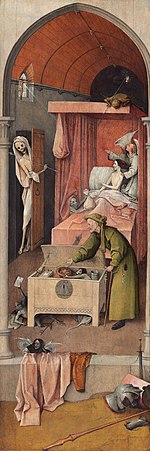
Species of madness

Death and the Miser
Hieronymus Bosch
from Wikipedia
But when a miser thinks nothing save money or coins, or an ambitious man of nothing save honour, these are not thought to be insane, for they are harmful and are thought worthy of hatred. But in truth, avarice, ambition, lust, etc., are nothing but species of madness, although they are not enumerated among diseases.
Benedict Spinoza – Ethics – Boyle translation.

Spinoza had a thing about ambition. In his strangely austere writings, there are very few hints of the man behind the words because he wanted his philosophy to be judged purely on its own merits. Nobody now writes like Spinoza and I suppose few ever did. The need to persuade is too strong.    

Sunday, 15 January 2012

Underestimating yourself


For whatever a man imagines that he cannot do, he imagines it necessarily, and by that very imagination he is so disposed that in truth he cannot do what he imagines he cannot do. For so long as he imagines that he cannot do this or that, so long is he determined not to do it: and consequently, so long it is impossible to him that he should do it. However, if we pay attention to these things, which depend solely on opinion, we shall be able to conceive that a man should under-estimate himself.
Benedict Spinoza - Ethics – Boyle translation