Pages

Showing posts with label Dickens. Show all posts

Tuesday, 23 June 2026

Crisis brings clarity? It does indeed


'London is cooking': UN chief issues warning as he urges countries to cut fossil fuels

He warned that climate chaos is “accelerating before our eyes” while the arrival of the El Nino warming weather phenomenon this summer risks “blowing the house down”

Speaking at the event on Tuesday, Mr Guterres said: “Crisis brings clarity and here in London – the city of Dickens – it is clear that our world is facing a ‘tale of two crises’.


It completely conveyed the idea of a man who had been born, not to say with a silver spoon, but with a scaling-ladder, and had gone on mounting all the heights of life one after another, until now he looked, from the top of the fortifications, with the eye of a philosopher and a patron, on the people down in the trenches...

We talk about the tyranny of words, but we like to tyrannize over them too; we are fond of having a large superfluous establishment of words to wait upon us on great occasions; we think it looks important, and sounds well. As we are not particular about the meaning of our liveries on state occasions, if they be but fine and numerous enough, so, the meaning or necessity of our words is a secondary consideration, if there be but a great parade of them.

Charles Dickens - David Copperfield (1849-50)

Saturday, 7 February 2026

When they give away what belongs to other people


There can be no doubt that at least one Chuzzlewit came over with William the Conqueror. It does not appear that this illustrious ancestor ‘came over’ that monarch, to employ the vulgar phrase, at any subsequent period; inasmuch as the Family do not seem to have been ever greatly distinguished by the possession of landed estate. And it is well known that for the bestowal of that kind of property upon his favourites, the liberality and gratitude of the Norman were as remarkable as those virtues are usually found to be in great men when they give away what belongs to other people.

Charles Dickens – Martin Chuzzlewit (1843 -1844)


But how is this legal plunder to be identified? Quite simply. See if the law takes from some persons what belongs to them, and gives it to other persons to whom it does not belong. See if the law benefits one citizen at the expense of another by doing what the citizen himself cannot do without committing a crime.

Frédéric Bastiat - The Law (1850)


Yet it's much more than money, always was.

Thursday, 29 January 2026

A Boil upon the face of society


Always something in the nature of a Boil upon the face of society, Mr. Honeythunder expanded into an inflammatory Wen in Minor Canon Corner. Though it was not literally true, as was facetiously charged against him by public unbelievers, that he called aloud to his fellow-creatures: “Curse your souls and bodies, come here and be blessed!” still his philanthropy was of that gunpowderous sort that the difference between it and animosity was hard to determine.

Charles Dickens – The Mystery of Edwin Drood (1870)


Strangely enough there is still a curious lack of difference between malice and the loudly intransigent  virtue-signalling of Mr. Honeythunder. Accept the saintly virtue of the climate narrative or be cursed forever is the kind of thing we have to endure today.

We don’t know what happened to Mr. Honeythunder because Dickens died before the novel was finished, but no doubt he would have encountered Nemesis towards the end of the novel. Doesn’t end like that today.

Saturday, 10 January 2026

From Sacred to Sacred


Deeply impressed with their sacred calling—for Mrs. Jackson would never have acknowledged that the Vicar’s wife held a position inferior to the Vicar’s—they argued that the whole world was God’s, and they God’s particular ministrants; so that it was their plain duty to concern themselves with the business of their fellows—and it must be confessed that they never shrank from this duty.

W. Somerset Maugham - The Hero (1901)


It is clear enough that many people with strong politically 'progressive' beliefs also regard their beliefs as sacred, and not to be questioned by outsiders. Neither do they shrink from their plain duty to concern themselves with the business of their fellows. 

It's a striking similarity which in recent decades has become too striking to be missed by even casual observation. Suppose we make some minor amendments to the above quote as an illustration.


Deeply impressed with their sacred calling—for Ms. Jackson would never have acknowledged that the Minister’s partner held a position inferior to the Minister’s—they argued that the whole world was One, and they its particular ministrants; so that it was their plain duty to concern themselves with the business of their fellows—and it must be confessed that they never shrank from this duty.

Not quite W. Somerset Maugham


Suppose we go on to try an older example -


...the perplexing mystery of the place was, Who belonged to the eighteen denominations? Because, whoever did, the labouring people did not.

Nor was it merely the stranger who noticed this, because there was a native organization in Coketown itself, whose members were to be heard of in the House of Commons every session, indignantly petitioning for acts of parliament that should make these people religious by main force.

Charles Dickens – Hard Times (1854)


Or by following the theme we could have -

...the perplexing mystery of the place was, Who belonged to the political denominations? Because, whoever did, the working people did not.

Nor was it merely the stranger who noticed this, because there was a native organization in Coketown itself, whose members were to be heard of in the House of Commons every session, indignantly petitioning for acts of parliament that should make these people politically progressive by main force.

Not quite Charles Dickens

Tuesday, 18 November 2025

Starmer has complete confidence in Starmer


Starmer vows to lead Labour into next election despite terrible polls


Sir Keir Starmer has insisted he will lead Labour into the next general election - as a poll suggested only a third of his own voters want him to.

The Prime Minister said he was “utterly focused” on tackling the cost of living, as he warned Labour against wasting time on leadership rows.

Sir Keir used a Mirror interview to attempt to silence doubts about his position, after the extraordinary briefing war last week over suggestions Health Secretary Wes Streeting was plotting a leadership challenge.


His gravity was unusual, portentous, and immeasurable, not because he admitted any doubt of himself but because he perceived it necessary to forestall any doubt of himself in others. And herein he ranged with that very numerous class of impostors who are quite as determined to keep up appearances to themselves, as to their neighbours.

Charles Dickens – Our Mutual Friend (1864-1865)

Sunday, 5 October 2025

The audacity to begin


Suppose we take Sir Keir Starmer as an example of someone who utters abominable nonsense as Charles Dickens’ oily character Mr Chadband does in Bleak House.


So, Mr. Chadband—of whom the persecutors say that it is no wonder he should go on for any length of time uttering such abominable nonsense, but that the wonder rather is that he should ever leave off, having once the audacity to begin—retires into private life until he invests a little capital of supper in the oil-trade.

Charles Dickens - Bleak House (1852-53)


There is a useful question here. It’s not only Starmer’s abominable nonsense we wonder at, nor that he carries on with it, but how did he ever have the audacity to begin?

The point to be made is that millions of us don’t have that level of audacity or anything like it. We can’t begin to spout the abominable nonsense Starmer spouts. Where did the required audacity come from and when?

Tuesday, 15 July 2025

A shriek in the supermarket


A shrieking child in the supermarket - familiar enough to all so there is no point paying much attention to it, but it does raise the issue of how long it can take to come down from an emotional outburst.

Worth pondering because there are adults who also take too long to come down from an emotional outburst even though they don’t fill a supermarket with unappeasable shrieks. At a quieter level though – that may be just what they do and it may go on for much longer than the shrieking child.

If we go off at a tangent to this problem of not letting go, then we come across another familiar type of behaviour. We come across people who can’t let go of a weak argument, dubious standpoint, misplaced loyalty or even a factual inaccuracy. It can be emotionally disturbing to let go in such cases. There are no shrieks in the supermarket, but it can seem undignified.

Yet if enough members of the same social class share the same dubious standpoint, the same loyalties and even the same factual inaccuracy, then no dignity is lost by holding onto it. Being wrong can be the dignified standpoint. Even a pompous idiot can be dignified in these circumstances. There is such a thing as dignified idiocy, as Dickens frequently highlighted.


Mr Podsnap, as a representative man, is not alone in caring very particularly for his own dignity, if not for that of his acquaintances, and therefore in angrily supporting the acquaintances who have taken out his Permit, lest, in their being lessened, he should be.

Charles Dickens - Our Mutual Friend (1864–1865)

Tuesday, 6 May 2025

They leave flavour of their graves behind them

 
Source


Two passages from Charles Dickens’ Bleak House are a reminder of the demise of country houses. In this case it’s the demise of the fictional Dedlock family and Chesney Wold, their ancient family seat in Lincolnshire.


Chesney Wold is shut up, carpets are rolled into great scrolls in corners of comfortless rooms, bright damask does penance in brown holland, carving and gilding puts on mortification, and the Dedlock ancestors retire from the light of day again. Around and around the house the leaves fall thick, but never fast, for they come circling down with a dead lightness that is sombre and slow. Let the gardener sweep and sweep the turf as he will, and press the leaves into full barrows, and wheel them off, still they lie ankle-deep. Howls the shrill wind round Chesney Wold; the sharp rain beats, the windows rattle, and the chimneys growl. Mists hide in the avenues, veil the points of view, and move in funeral-wise across the rising grounds. On all the house there is a cold, blank smell like the smell of a little church, though something dryer, suggesting that the dead and buried Dedlocks walk there in the long nights and leave the flavour of their graves behind them.

Charles Dickens - Bleak House (1852-53)


Even by Dickens’ time, the lure of a cosmopolitan life had created a sharp contrast with the staid life of managing a country estate with its onerous management, upkeep costs and predictable social routines. It was a trend all Dickens’ readers would have known about, linked to social changes which came with railways, steamships and new sources of wealth.

Now we have the National Trust looking after many of those country houses, an organisation mired in its own organic, low-carbon, midwit limitations. The NT never seems to bring out the vast significance of it all, the migration of the ruling class from country estate to cosmopolitan city life and on to fashionable resorts across the world. The trend continues.


But the house in town, which is rarely in the same mind as Chesney Wold at the same time, seldom rejoicing when it rejoices or mourning when it mourns, excepting when a Dedlock dies—the house in town shines out awakened. As warm and bright as so much state may be, as delicately redolent of pleasant scents that bear no trace of winter as hothouse flowers can make it, soft and hushed so that the ticking of the clocks and the crisp burning of the fires alone disturb the stillness in the rooms, it seems to wrap those chilled bones of Sir Leicester’s in rainbow-coloured wool.

Charles Dickens – Bleak House

Sunday, 10 November 2024

Agnew v Dickens


One hundred and eighty eight years ago, Charles Dickens published an essay "Sunday Under Three Heads", an attack on Sir Andrew Agnew and his repeated attempts to introduce a strict Sabbath Observance Bill in the House of Commons.


Agnew was Member of Parliament for Wigtownshire, 1830–1837. He stood as a moderate reformer, but soon became deeply attached to the cause of Sabbatarianism, and pressed for the banning of all secular labour on Sunday. For this purpose he introduced no less than four Sabbath Observance Bills in the Commons, none of which passed.[1] It was the third attempt which drew on him the wrath of Charles Dickens, whose essay Sunday Under Three Heads (1836) is very largely a personal attack on Agnew,[2] whom he described as a fanatic, motivated by resentment of the idea that those poorer than himself might have any pleasure in life.


One of Dickens' many criticisms was that the Bill would clamp down on the poor but not the rich, even though Sunday was often the only day of rest available to the poor. A comparison with Net Zero is obvious - the Puritanical suppression of working people for spurious reasons of spurious virtue. 


With one exception, there are perhaps no clauses in the whole bill, so strongly illustrative of its partial operation, and the intention of its framer, as those which relate to travelling on Sunday.  Penalties of ten, twenty, and thirty pounds, are mercilessly imposed upon coach proprietors who shall run their coaches on the Sabbath; one, two, and ten pounds upon those who hire, or let to hire, horses and carriages upon the Lord’s day, but not one syllable about those who have no necessity to hire, because they have carriages and horses of their own; not one word of a penalty on liveried coachmen and footmen.  The whole of the saintly venom is directed against the hired cabriolet, the humble fly, or the rumbling hackney-coach, which enables a man of the poorer class to escape for a few hours from the smoke and dirt, in the midst of which he has been confined throughout the week: while the escutcheoned carriage and the dashing cab, may whirl their wealthy owners to Sunday feasts and private oratorios, setting constables, informers, and penalties, at defiance.  Again, in the description of the places of public resort which it is rendered criminal to attend on Sunday, there are no words comprising a very fashionable promenade.  Public discussions, public debates, public lectures and speeches, are cautiously guarded against; for it is by their means that the people become enlightened enough to deride the last efforts of bigotry and superstition.  There is a stringent provision for punishing the poor man who spends an hour in a news-room, but there is nothing to prevent the rich one from lounging away the day in the Zoological Gardens.

Charles Dickens - Sunday Under Three Heads (1836)


What particularly seemed to rile Dickens was how blatant it all was. As blatant as we see today with rich proponents of Net Zero flying around in private jets. The similarity is difficult to miss.

Friday, 5 April 2024

A pint at bedtime


By this time the pot-boy of the Sol's Arms appearing with her supper-pint well frothed, Mrs. Piper accepts that tankard and retires indoors, first giving a fair good night to Mrs. Perkins, who has had her own pint in her hand ever since it was fetched from the same hostelry by young Perkins before he was sent to bed.

Charles Dickens – The Old Curiosity Shop (1841)


Or better still –


Nodding his approval of this decisive and manly course of procedure, the landlord retired to draw the beer, and presently returning with it, applied himself to warm the same in a small tin vessel shaped funnel-wise, for the convenience of sticking it far down in the fire and getting at the bright places. This was soon done, and he handed it over to Mr Codlin with that creamy froth upon the surface which is one of the happy circumstances attendant on mulled malt.

Charles Dickens – The Old Curiosity Shop (1841)

Tuesday, 14 November 2023

Predictions that never come to pass


I have tamed that savage stenographic mystery. I make a respectable income by it. I am in high repute for my accomplishment in all pertaining to the art, and am joined with eleven others in reporting the debates in Parliament for a Morning Newspaper. Night after night, I record predictions that never come to pass, professions that are never fulfilled, explanations that are only meant to mystify.

Charles Dickens - David Copperfield (1849-50)


We all know this, but one of the great curses on our age is prediction. It attracts crooks, charlatans and cranks, causes immense and obvious damage yet still it goes on.

Where will it all end? Don’t ask the crooks, charlatans or cranks, they don’t know. 

Saturday, 24 December 2022

Scrooge Repents


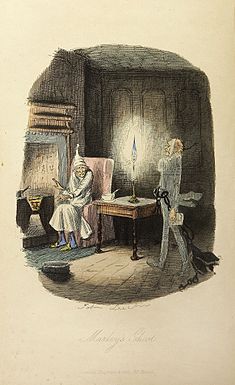
Christmas eve found Scrooge in his place of business, alone with his ledgers and his solitary candle. Bob Cratchit was away with a slight cold although Scrooge had a suspicion that Bob had taken time off because he was busy decorating his new house.

Scrooge sighed a curiously dissatisfied sigh. The Cratchits had moved up the social ladder since Scrooge raised Bob’s salary. Bob himself was becoming more rotund on good living, and as for that great hulking son of his, Tiny Tim –

There had been a good many changes over the last few years, Scrooge reflected, a good many changes. He sighed a deep sigh as he donned his coat in preparation for making his way home. Wearily he extinguished a single tallow candle before trudging through dark, snowy streets towards a lonely, but richly decorated home. No uncarpeted floors now.

As always on Christmas eve, Marley’s face appeared on Scrooge’s door knocker, but this time, Scrooge responded by punching the ghostly image on its ghostly nose. All he received for his pains were bruised fingers.

Later that lugubrious evening, crouched over another savoury but remarkably expensive dinner, Scrooge reflected on his years of manic generosity. All brought on by Marley’s untrustworthy ghost, Scrooge mused, and those visitations from three Christmas spirits. Thanks to their urging he was surely headed towards destitution.

“A trickle of income enough to pay Bob Cratchit his ruinous salary and keep Tiny Tim supplied with pies plus more dinner than I can eat for myself”, Scrooge muttered when a muffled step on the stair disturbed his musing. Scrooge listened intently. He had heard that sound once before

The chamber door slammed open and an unearthly voice boomed out –

“Scrooge – are you there Scrooge?”

“Of course I am. Where else would I be? I presume it is you again, Marley.” Scrooge barely troubled himself to glance around his chair to see, as expected, Marley’s spirit.

“It is I, Marley,” boomed the spirit, as if determined not to be upstaged by the chilly indifference exhibited by his erstwhile business partner.

“So where are all the chains, cash boxes and what not?” Scrooge scrutinised Marley’s spirit more closely than before. For indeed all the ponderous chain that formerly had burdened Marley’s spectre with such regretful anguish was gone. Every link, every cash box. All gone.

“All gone thanks to you Scrooge,” intoned the spirit. “Thanks to your inestimable generosity.”

“Thanks to my foolish spendthrift imbecility,” muttered Scrooge into his dinner. “My ruinous generosity,” he added bitterly.

“Once you did not believe in me,” the spirit boomed, as if anxious to change the subject.

“Oh I believe in you now,” Scrooge glared through Marley to the seat buttons at his intangible back.

“Well then,” Marley continued, “I have arranged for three spirits –“

“Oh no, oh no Marley. Not those three spirits again.”

“Three different spirits Scrooge. Three completely different spirits with an entirely different yet wholly altruistic purpose. They all appear on the stroke of one – a very good night to you Scrooge.” With that, Marley’s ghost vanished as completely as if it had an urgent appointment after a painful but necessary duty.

Reluctantly Scrooge retired for the night after a sour glance in the direction of richly expensive bed hangings which he heartily regretted purchasing in a moment of madness. He soon fell into an uneasy slumber as was his wont in those difficult days.

The church bell struck one o’clock. A deep, sonorous note, an unearthly note –

“Who is that? Who is there?” Scrooge awoke with a start, peeped cautiously through the bed hangings but all was darkness –

“Nothing.” Relieved, Scrooge lay back on absurdly expensive silk pillows when – hark! What is this? A brilliant light filtered into his by now somewhat doubting eye. Three ghostly figures stood by his bed.

“You again – and bless my soul there are three of you now. I presume you three are the ghosts of Christmas past, present and future all come together. How efficient of you, if I may say so.” Wearily Scrooge peered through the bed curtains. “That is to say my past, present and future so I should be greatly obliged if you just get on with it.”

“Certainly,” replied the spirits in unison. They immediately disappeared, only to reappear after a few seconds, laboriously pulling a huge trunk across the floor. “My word this is heavy,” said Christmas past, seating himself on the great trunk while mopping an insubstantial brow with something equally insubstantial.

“Frightfully heavy,” Christmas present added. The ghost of Christmas yet to come said nothing.

“As if hoping for a tip,” thought Scrooge. “What is in it to make it so heavy?” he asked.

“Your riches, all of your gold accumulated over all those years. Until you squandered it of course. You never did remember the lesson old Fezziwig should have taught you.”

“What lesson – ” Instantly Scrooge was transported to exactly the location of his previous ghostly visit, the workplace and abode of old Fezziwig.

Scrooge and the three spirits were just in time to catch old Fezziwig taking a break from the Christmas festivities while his employees danced on. Old Fezziwig winked at his wife and whispered quietly, “only cost a few shillings Mrs Fezziwig, only a few shillings.”

“Was old Fezziwig such a cynic?” Scrooge asked the spirits.

“No – merely a realist,” replied the ghost of Christmas past. “Nobody would suggest that he should endanger his business to celebrate Christmas. Others would suffer too were he to allow that to happen.”

“As I suffer now,” Scrooge was heard to mutter as the spirits whisked him away. “That didn’t last long,” Scrooge grumbled as the spirits unceremoniously deposited him back to his bed chamber.

“You cannot afford a longer tour, as you probably realise by now” replied the spirits. “Goodbye.” With that, the ghost of Christmas past vanished and the Christmas present stepped forward to Scrooge’s bedside.

“You, as I already know, are the ghost of Christmas present,” Scrooge gasped, still somewhat breathless after such a rapid return from such a brief spell with the Fezziwigs and his own past.

“I am the ghost of Christmas present,” replied the spectre, “and we may as well get on with it because we don’t have much time. We’ll begin where my compatriot left off.”

“But – ”

Scrooge attempted to protest at what he deemed to be undue haste, but before he could add voice to his protest he found himself in a vaguely familiar street. The ghost of Christmas present stood before him. The ghost of Christmas yet to be lurked behind.

“I already know what they are.” Scrooge pointed a trembling finger in the direction of two bulges under the spectre’s coat. A young boy and girl peeped out, but not as before, not by any means. These children were distinctly overweight for one thing.

“Spirit! are they yours? But I asked that the last time.” Scrooge could say no more.

“They are Man’s,” said the spirit again. “This boy is Ignorance. This girl is Want. Beware them both, and all of their degree, but most of all beware this boy, for on his brow I see that written which is Doom, unless the writing be erased.”

“Well their requirements are substantially unchanged from last time,” observed Scrooge, “although bodily nourishment does not appear to be wanting.”

“You are probably right, times change.” The spirit shrugged insubstantial shoulders and in a moment, both spirit and children vanished. Scrooge found himself in a familiar, sombre location, a dark and gloomy street apparently bereft of all life save Scrooge himself and the ghost of Christmas yet to be.

“Hello ghost of Christmas yet to come – we met on a previous occasion,” said Scrooge, almost cheerful as his ordeal seems to be nearing its end.

The spirit said nothing but merely pointed towards the great chest which the three spirits had transported to Scrooge’s chamber, the symbol of lost wealth.

“What am I to do with that?” asked Scrooge.

The spirit shrugged, vanished and the pure light of a snowy Christmas morning filtered through Scrooge’s bed curtains as he awoke. He leaped out of bed and rushed to his chamber window, just in time to see a boy strolling through the snow below his window, almost the same boy Scrooge had paid to deliver that huge turkey to Bob Cratchit a few short years ago.

“Hello there, little boy,” shouted Scrooge through the opened window.

“Watcha,” said the boy.

“What a delightful boy – excellent boy and probably cheap enough for what I have in mind. Hey little boy, do you know where Bob Cratchit lives?” Scrooge shouted.

“Do I know that big new ‘ouse? I should say so, old ‘un,” the boy replied.

Delighted with the boy’s response Scrooge scribbled a hasty note requiring Cratchit to attend the office for the whole of Christmas day or face instant dismissal. “Take this note round to Bob Cratchit and I’ll give you a shilling,” said Scrooge, tossing the note and the shilling down to the boy.

Scrooge slammed the window and rubbed his hands. “Sixpence would have been enough, but I’ll sell those bed curtains next,” he chuckled. “The vultures may have the old ones when I’m gone – why should I care? I’ll rebuild my fortune before that – and won’t I enjoy building it?”

Scrooge rubbed his hands again. “Gruel first, then the office” he said cheerfully.

Thursday, 22 July 2021

The Spirit of the Age


There was a time not so far in the past when ignorance was feared and education was seen as the antidote. Ignorance could lead to crime, disorder, riots and subversion. Of course the drive to educate the masses had a number of aspects, but one which has declined in perceived importance is a visceral fear of widespread ignorance.

Why we should fear it is obvious enough - widespread ignorance takes us into the unknown where painfully acquired cultural competence begins to fall apart. 

In his short story 'A Son of the Soil', writer George Gissing introduces us to his character Jonas Clay, an agricultural labourer who aspires to better himself in London. Unfortunately Clay’s aspiration is founded idle ignorance rather than anything more constructive. It doesn’t end well of course. Gissing was no great fan of happy endings.

At school he had learnt — well, what had he learnt? In the main, to spell out police news and to scrawl obscene words. His education, in the real sense, he owed to a powerful but unacknowledged instructor, the Spirit of the Age. Hence his discontent with everything about him, his thorough dishonesty, his blurred, gaslight vision of a remote world.

Certain well-meaning persons had given him ‘religious teaching,’ that is to say, had laboriously brought him to the repetition of phrases he did not understand, to which he attached no particular significance whatever. He could not name the flowers by the wayside; no one had ever thought of teaching him that. He did not know — he did not hear — the bird that sang to him at his work; no one had ever spoken to him of such trifles.

He was aware, by consequences, that the sun rose and set; but never had he consciously looked at its setting or its rising; for all that Jonas thought about it, the sky might have lowered in a perpetual leadenness. He had no conception of geography — save that somewhere vaguely to the east lay a huge town called London.


George Gissing – A Son of the Soil (1898)


As Gissing wrote of Jonas Clay: His education, in the real sense, he owed to a powerful but unacknowledged instructor, the Spirit of the Age. Where are we if the spirit of our age actively promotes ignorance? Which it does – we know it does in ways too numerous to count. Perhaps this is a situation we should fear.

Charles Dickens gives us an earlier and better-known hint that ignorance is something to be feared in 'A Christmas Carol'. It isn’t a new problem but what we seem to have forgotten is the fear itself and the reasons why we should still fear ignorance.

Scrooge started back, appalled. Having them shown to him in this way, he tried to say they were fine children, but the words choked themselves, rather than be parties to a lie of such enormous magnitude.

“Spirit! are they yours?” Scrooge could say no more.

“They are Man’s,” said the Spirit, looking down upon them. “And they cling to me, appealing from their fathers. This boy is Ignorance. This girl is Want. Beware them both, and all of their degree, but most of all beware this boy, for on his brow I see that written which is Doom, unless the writing be erased. Deny it!” cried the Spirit, stretching out its hand towards the city. “Slander those who tell it ye! Admit it for your factious purposes, and make it worse. And bide the end!”

Charles Dickens – A Christmas Carol (1843)

Saturday, 17 July 2021

Look at the pretty rainbow


We talk about the tyranny of words, but we like to tyrannize over them too; we are fond of having a large superfluous establishment of words to wait upon us on great occasions; we think it looks important, and sounds well. As we are not particular about the meaning of our liveries on state occasions, if they be but fine and numerous enough, so, the meaning or necessity of our words is a secondary consideration, if there be but a great parade of them.

And as individuals get into trouble by making too great a show of liveries, or as slaves when they are too numerous rise against their masters, so I think I could mention a nation that has got into many great difficulties, and will get into many greater, from maintaining too large a retinue of words.


Charles Dickens - David Copperfield (1849-50)

Even in Dickens’ day it was clear enough that words are misused and the meaning of what is said or written may not reflect a genuine standpoint. Words are used for effect, a problem we’ve been familiar with forever.

There may be no meaning at all, nothing but a play on the emotions and susceptibilities. We see it all the time as politicians and the media play their tired tunes on allegiances, fears and emotional cues. Doing their tedious best to ensure that nonsense wins again.

A core problem seems to be that picking apart misleading language has little impact on anyone. We see it all over the internet. There is little point in trying to pull apart a widely-reported celebrity comment by showing it to be meaningless. It doesn’t matter if it is meaningless in an analytical sense. The emotional effect is what matters, not the meaning. The emotional effect is the meaning.

We know this too, but cannot do anything about it. We drown in a barrage of words, flounder around in words which lack the most basic analytical integrity. Even education can’t do anything about that. We want kids to be engaged, of course we do, but meaningless words are infinitely engaging. Look at the pretty rainbow – see all the happy genders.

Friday, 4 December 2020

The shadow of Old Nick


I’ve used this Dickens quote before. It is one of my favourites as it so neatly encapsulates an endemic and ineradicable feature of the law –

The one great principle of the English law is, to make business for itself. There is no other principle distinctly, certainly, and consistently maintained through all its narrow turnings. Viewed by this light it becomes a coherent scheme, and not the monstrous maze the laity are apt to think it. Let them but once clearly perceive that its grand principle is to make business for itself at their expense, and surely they will cease to grumble.

Charles Dickens - Bleak House (1852-53)

Even better - the quote may be adapted to generate a number of grand principles simply by substituting something equally applicable in place of the words English law. For example –

The one great principle of the establishment is, to make business for itself. There is no other principle distinctly, certainly, and consistently maintained through all its narrow turnings. Viewed by this light it becomes a coherent scheme, and not the monstrous maze the laity are apt to think it. Let them but once clearly perceive that its grand principle is to make business for itself at their expense, and surely they will cease to grumble.

Another example illustrate how virtue may replace business, take may replace make and still it works –

The one great principle of the establishment is, to take virtue for itself. There is no other principle distinctly, certainly, and consistently maintained through all its narrow turnings. Viewed by this light it becomes a coherent scheme, and not the monstrous maze the laity are apt to think it. Let them but once clearly perceive that its grand principle is to take virtue for itself at their expense, and surely they will cease to grumble.

To my mind Dickens has given us a fascinating insight where, in a range of guises, this is what the establishment always has done at our expense. Almost as if in the basic shape of the thing we see the malign shadow of Old Nick himself.

Sunday, 9 December 2018

A Christmas Carol


Charles Dickens’ cautionary tale about the emotional blackmail behind Christmas is often misinterpreted.

December is here and yet again Christmas makes its horribly garish intrusions onto our winter horizon. The nightmarish swindle now infests every nook and cranny of daily life so perhaps we should take a little time to remind ourselves of the real warning behind Dickens’ obliquely crafted tale.


It is the night before Christmas and at the end of a working day Ebenezer Scrooge, a thrifty and conscientious businessman has a few words with his clerk Bob Cratchit who timidly but firmly insists on having Christmas off with full pay.

"You'll want all day to-morrow, I suppose?" said Scrooge.

"If quite convenient, sir."

"It's not convenient," said Scrooge, "and it's not fair. If I was to stop half-a-crown for it, you'd
think yourself ill-used, I'll be bound?"

The clerk smiled faintly.

Later that evening Scrooge encounters the ghost of his erstwhile partner Marley. As any good friend would do, Marley’s ghost warns Scrooge that three more spectres will try to entice his old friend away from the paths of sober competence and do their supernatural best to persuade him to initiate the welfare state single-handedly. Lots of dismal wailing and rattling of spectral chains hammer home the message. Understandably Scrooge is somewhat uneasy as he takes to his bed that night.

The first spectre to appear as foretold by Marley is the ghost of Christmas past which appears at Scrooge’s modest bedside during the night. This first spectre takes Scrooge into his own past, showing him how he first set foot on the rungs of the business ladder, wisely ditching a clingy and potentially expensive fiancée at an early stage.

Unfortunately these pleasant scenes of his early years only serve to upset Scrooge’s moral equilibrium to such a degree that he almost regrets his outstanding success as a businessman. In particular, a former tightwad employer named Fezziwig is shown in a highly favourable light as he entertains his staff on Christmas Eve with minimal expenditure and no lost production.

"A small matter," said the Ghost, "to make these silly folks so full of gratitude."

"Small!" echoed Scrooge.

The Spirit signed to him to listen to the two apprentices, who were pouring out their hearts in praise of Fezziwig: and when he had done so, said, "Why! Is it not? He has spent but a few pounds of your mortal money: three or four perhaps. Is that so much that he deserves this praise?"

A small matter indeed. Crafty old Fezziwig - although by now Scrooge is so stunned that he does not see that it is indeed a small matter.

The second ghost of Christmas present is initially more promising in that he is introduced as being surrounded by a vast heap of Christmas goodies of the edible variety. It is worth mentioning at this point that Scrooge’s diet is possibly a little narrow so the abundant if ghostly Christmas fare may contain a reasonable dietary message.

Heaped up on the floor, to form a kind of throne, were turkeys, geese, game, poultry, brawn, great joints of meat, sucking-pigs, long wreaths of sausages, mince-pies, plum-puddings, barrels of oysters, red-hot chestnuts, cherry-cheeked apples, juicy oranges, luscious pears, immense twelfth-cakes, and seething bowls of punch, that made the chamber dim with their delicious steam. In easy state upon this couch, there sat a jolly Giant, glorious to see; who bore a glowing torch, in shape not unlike Plenty's horn, and held it up, high up, to shed its light on Scrooge, as he came peeping round the door.

"Come in!" exclaimed the Ghost. "Come in! and know me better, man!"

However the initial promise is not maintained as the ghost of Christmas present manages to insinuate the suggestion that such goodies and much, much more might be given away to feckless folk who have not paid for them. Still stunned by the whole experience Scrooge seems inclined to agree with such reckless extravagance.

The third ghost of Christmas future in more of a realist who by dramatic devices manages to suggest that Scrooge is surrounded by thieves who after his death would strip his dead body, steal his bed hangings and sell everything they could lay their hands on. So far so good but there is a sting in the tail. The ghost of Christmas future somehow manages to leave Scrooge with the impression that he may as well give things away now because after his death they will be stolen anyway.

For some unaccountable reason all this ghostly propaganda leaves Scrooge in a state of manic elation when he finally wakes up on Christmas morning. Neither narcotics nor alcohol are involved because Dickens clearly intended to highlight the perils of the most intense and unrelenting propaganda on an otherwise sober mind.

By Christmas morning Scrooge is so out of it that he even sends a large turkey to that financially feckless employee Bob Cratchit. Small income but a large family – that’s Bob Cratchit. If only we had imbibed this key message from the master story teller, but we never did.

And so began the first stirrings of emotional incontinence. One might almost suggest that Dickens invented it as a warning to us all, but somehow we turned it into soppy sentimentalism and have suffered for our mistake ever since.

Thursday, 5 April 2018

A veil of caricature


Charles Dickens was a fine writer but he tended to cast a veil of caricature over grim realities. For example in Nicholas Nickelby, Wackford Squeers was horrible but Dotheboys Hall was probably not as horrible as the worst of the Yorkshire schools Dickens was castigating. Although he showed his readers what was going on, he glossed over the grisly details via caricature. Caricature tends to do that.

As a contrast we have Sheridan Le Fanu’s novel The Fortunes of Colonel Torlogh O'Brien published only a few years later. Here a grisly and prolonged description of death by the strappado leaves the reader  in no doubt about the inhuman nature of this appalling torture. No veil of caricature here. Dickens would never have tackled it even in the most oblique manner. 

Illustration by Phiz – somehow that seems to make the contrast even more stark.


At the word, the men let the rope go, and the living burthen which they had so lately raised, shot downwards from his elevated position to the point at which, as we have said, the rope was fixed; then; his descent was arrested with a dislocating shock which wrenched his arms almost from the shoulder sockets. With a yell so appalling that it dashed with a momentary horror, even the faces of the executioners themselves, the miserable man testified the unendurable anguish of the dreadful torture; rolling his head and his eyes around, in the delirium of his fierce agony, he shrieked forth blasphemies and prayers in wild and terrible incoherence. 

“Pike him, an’ put him out of pain, for God’s sake, will yez?” cried one of the spectators, with the energy of horror, and wincing under the frightful spectacle.

Sheridan Le Fanu - The Fortunes of Colonel Torlogh O'Brien (1847)

Thursday, 4 May 2017

A righteous man

For fifty years he had been persuading himself that he was a righteous man, and the conviction was now so firmly impressed upon his very soul that nothing could ever shake it.
Sir Arthur Conan Doyle – The Firm of Girdlestone (1890)

It’s a strange idea, the notion of righteousness. So often we have seen it applied to fictional characters who are emphatically not righteous, as Conan Doyle does here with John Girdlestone and as Dickens did with Seth Pecksniff. Both characters projected their supposed righteousness via religious and traditionally moral facades. 

Righteousness still has religious connotations, but much less so than in Dickens’ and Conan Doyle’s day. Even so, in view of her religious upbringing one might expect Theresa May to have a degree of righteousness in her political persona but she doesn’t. Neither does Jeremy Corbyn, yet Conan Doyle’s quote seem to fit Corbyn better than May. It fits his politics, it fits his supporters.

In modern times, the whole idea of righteousness has become much more political and rather more covert. It is signalled via behaviour and language rather than explicit religious quotations or moral maxims. It has morphed into political virtue-signalling and is not likely to be religious nor traditionally moral.

It was easy enough in Dickens' and Conan Doyle's day, but somehow we have made it even easier to be righteously stupid, righteously incompetent, righteously dishonest, righteously wicked. 

Sunday, 15 June 2014

The one great principle

The one great principle of the English law is, to make business for itself. There is no other principle distinctly, certainly, and consistently maintained through all its narrow turnings. Viewed by this light it becomes a coherent scheme, and not the monstrous maze the laity are apt to think it. Let them but once clearly perceive that its grand principle is to make business for itself at their expense, and surely they will cease to grumble.
Charles Dickens - Bleak House

I’ve used this Dickens quote before because it's a favourite of mine with wide applicability.

For example, If the word government is substituted for English law, it almost becomes a law of nature. It's what I observed for most of my working life - government making business for itself. Mostly during the latter years of my sentence - as life became progressively more bureaucratic.

The commercial world makes business for itself  but government has the power to do it without the trouble and inconvenience of attracting customers. Hence the close links between big business and big government. Certain professions and organisations cuddle up to government for the same reason.

From this aspect, Dickens’ monstrous maze covers anything from minutiae such as the date of the next meeting (because there always has to be one) to protecting ministerial budgets to promoting custom and practice as a guiding principle. And yes, I have heard custom and practice used as an argument for resisting beneficial change.

Take science for example. A key reason why it is so politically attractive to bend science into a policy instrument is that it creates business. Business for government, people in government, corporations entangled with government, government supported charities - and of course scientists.

The nutritional sciences are a case in point. What is nutritional advice worth after decades of study and the expenditure of uncounted billions? May I suggest an answer somewhere in the vicinity of not much? May I further suggest that a moderate and varied diet seems to cover it?

As far as I can see from personal experience, a traditional main meal of meat and two veg followed by a pud plus maybe a glass or two of something in the evening is fine. Not quite my taste, but it didn't cause my parents' generation to keel over at an early age. Too many calories do cause problems as does too much booze, but we've known that for centuries.

It doesn’t matter though – food fads give rise to food regulations and food regulations are business. Looping back to Dickens, it’s a coherent scheme.

Government bungles everything it touches, partly because bungling is good business too. Lessons can be learned, relearned then learned all over again. Newspapers report the bungles, committees investigate them, auditors audit them and politicians take advantage of them.

Let’s finish with a question and a possible answer.

How will the drugs problem be resolved?

Unfortunately it may well be the case that so much business is created by not resolving it that there is no business reason why it should ever be resolved. In that case, unless the drugs problem becomes a threat to social and political stability, unless it becomes a threat to government business, then the current situation seems likely to continue.

So maybe the drugs issue isn’t a question of weighing up moral choices or policies which do the least harm. Maybe it’s merely a question of whatever policy generates the most government business with the least political risk.

Sounds cynical, but when it comes to making those millions of micro-decisions which comprise social and political trends, then people can be very cynical indeed. Especially when it isn’t obvious – when custom and practice so conveniently sidestep the rational and ethical faculties.

When government folk are making business for themselves.