Pages

Sunday, 5 August 2012

Fracking for kids


The hydraulic fracturing, or fracking, of deep shale deposits is unearthing a lot of natural gas — and controversy

In the 2010 documentary Gasland, Colorado resident Mike Markham strikes a cigarette lighter next to his kitchen faucet. He turns on the tap and waits a beat. Whoosh! A fireball shoots from the flowing stream. 

The headline and first paragraph set the tone of the whole piece. The Gasland clip has been debunked, but not until the sixth paragraph are we actually told so. Or maybe I should say the kids aren't let in on it until the sixth paragraph, because this is science for kids isn't it? 

A 2010 report that this agency issued evidence suggesting underground coal seams might be the source of methane in the homeowner’s water, not a fracked gas deposit.

So why include the Gasland clip and the flaming tapwater if it had nothing to do with fracking? Rhetorical question I know - experience has taught us why. The piece as a whole is relentlessly negative, but does give a reasonable outline of the fracking process. Yet the intended message of gloom and excessive caution is perfectly clear and the huge scale of the potential benefits is not addressed. Instead we have such dismal warnings as:-

“The health science community is now looking at why health complaints are rising in fracking areas, particularly among children,” says Steinzor of Earthworks. She says that some people who live near fracking areas have been complaining of headaches, nausea, bloody noses and nerve problems. As a result: “New studies are delving into the pathways of exposure and what levels are dangerous.”

This would be an important finding if we could believe it, but energy issues are now hopelessly compromised because of the way advocacy is so often disguised as science. Fracking offers major benefits for our children and grandchildren and ideologues know it. 

Scare kids off fracking seems to be the aim. In only a few years, some of them may become activists, so job done I suppose.

Saturday, 4 August 2012

Bill and Ben talk climate


An notable aspect of climate science is that many non-scientists find it easily to spot what a crock it is without the need to gen up on the science or do much in the way of research. Climate alarmism is dishonest and people are pretty good at recognizing dishonesty. Nobody has to be an expert to pick up the stench.

Imagine a non-scientist sceptic named Bill, who like all of us pays the bills, and an honest climate scientist I’ve named Ben – because he isn’t bent.

Bill: Tell me Ben, when was the modern thermometer invented?
Ben: It was invented by Daniel Gabriel Fahrenheit in 1714.
Bill: So we only have accurate temperature records from 1741?
Ben: Yes.
Bill: Even so we don’t really know how accurate early temperature records are?
Ben: Not really – we can’t be sure how well they were calibrated or sited.
Bill: So about three hundred years at best.
Ben: No - more like a hundred years for global temperatures – if that.
Bill: And there are still problems with early records – coverage and so on.
Ben: Yes. It gets better, the nearer we are to the present.
Bill: Yet climate cycles can be much longer than a hundred years.
Ben: Yes they can. Ice age cycles are tens of thousands of years long.
Bill: And satellite measurements are even more recent than thermometer records.
Ben: Just over thirty years – yes.
Bill: So why are we so worried about climate change?
Ben: Well the rise of CO2 in the atmosphere is unprecedented.
Bill: You mean there has never been so much CO2 in the atmosphere?
Ben: No - CO2 levels have been far higher in the past.
Bill: So what’s the issue?
Ben: Well models tell us there may be an issue.
Bill: Models?
Ben: Computer models.
Bill: Ah.
Ben: They predict much higher global temperatures if CO2 levels continue to rise.
Bill: If CO2 rises to a level it hasn’t ever reached in the past?
Ben: No - not that high.
Bill: We’re not talking unprecedented CO2 levels then?
Ben: No.
Bill: So do climate models make accurate predictions?
Ben: No, but they model the past reasonably well.
Bill: Does that tell us anything useful?
Ben: No.
Bill: And they still can’t predict the future?
Ben: No.

And so on and so on. There is no CO2 climate theory - it’s all dishonest hype centred on computer models and politics. It cannot be promoted within reasonable bounds of scientific discourse because it just falls apart - there is nothing substantive to say.

It falls apart if Ben is honest, so Ben has to be dishonest, evasive or aggressive and that's what many non-scientists pick up on.

Friday, 3 August 2012

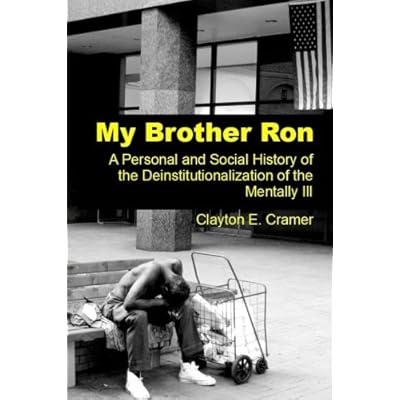
My Brother Ron


Ron has suffered from schizophrenia for most of his adult life. My Brother Ron is his story, a book written by his brother - blogger Clayton E Cramer. Schizophrenia is a dreadful thing to happen to anyone, but Cramer weaves another story around Ron and his personal disaster.

On a wider scale the book is an analysis of the deinstitutionalization of mental health care in America, in particular the way patients with serious mental illness were let out into the community. Much the same happened here in the UK and although this is an American story, Cramer draws a few parallels with the UK.

Obviously this isn’t an easy subject for anyone who holds dear the liberty of the individual. Some individuals can’t handle personal liberty through no fault of their own. Cramer is talking of serious mental illness here, mostly schizophrenia and psychosis, biochemical brain illnesses therapy can’t touch. He is not discussing the emotional kind.

Cramer’s book is a remarkably cool, dispassionate and meticulously researched analysis of how mental hospitals in the USA were closed down over a few decades, sometimes for the best of intentions, but certainly with some horrific results.

It isn’t a simple story though, because some people undoubtedly were better off outside mental hospitals and some mental hospitals were inadequate or worse than inadequate. But freezing to death on the streets dressed in urine-soaked rags has been just one consequence of closing mental hospitals. Killing sprees another.

It’s a complex and a morally and legally difficult subject. Cramer’s impressive book surely does an excellent job of telling the story. Available in paperback and Kindle format, it is a very sobering story, but a great read too.

Thursday, 2 August 2012

Free Kindle download

My Kindle book Green Bread can be downloaded free until August 6th.

Walk in the rain


The other day we managed a short walk. Only seven miles, but the second walk I’ve completed since a spell in hospital a couple of months back.

Part of the route took in Cromford canal in Derbyshire, an late eighteenth century canal now disused, but popular with walkers and designated as site of special scientific interest (SSSI). We find it more attractive than your usual canal.

Lined with trees, it’s a relaxing stroll with bits and pieces of industrial heritage to remind us why it was built. Leawood Pumping Station for example. It pumped water from the River Derwent to keep the canal topped up.


About a mile or so from the end of the walk it began to rain. Although we had waterproofs we didn’t bother putting them on. Apart from a real deluge you don’t usually need wet gear in summer. Clothes made from lightweight synthetics dry out as you walk and it’s pleasing to walk in the rain without feeling the need to find shelter.

Why is that? Maybe it’s that unique aroma you get from falling rain plus... Plus what? Maybe a sense of being outdoors - proper outdoors. We stood under nearby trees for a moment when it came down hard, watched it drip great fat drips into the canal from overhanging trees. Then we moved on.

I’m not usually keen on rain while out walking. It obscures the view and out on the hills I think there is an aspect of rain you don’t quite capture. It's just a nuisance really - not atmospheric as it can be elsewhere.

Maybe the aroma goes missing in the hills. It's softer and more peaceful down by the canal. Not a nuisance at all. With no view to lose, the rain adds a touch of something strangely pleasant, something more than a mild wetting.

Wednesday, 1 August 2012

Printed speakers

The magic of films


It seems to me that a huge number of films use a kind of temporary belief in magic to attain their effect, even though the incredible effects they achieve aren’t usually referred to magic. Batman, Superman, Spiderman etc are all magical beings. What they are and the things they do violate scientific laws, but we don’t care. It’s magic.

I grew up on cowboy westerns where the hero drew his gun with magical speed and fired it with magical accuracy. He also had iron fists with bones which never broke however hard he hit the villain. Broken hand bones was a problem which boxing gloves were designed to prevent, yet our hero doesn’t wear boxing gloves and his hands don’t break. Magic fists.

Surprisingly, or perhaps not so surprisingly, the use of magic in films is even more prevalent today. Everything from Toy Story to Shrek, from ET with his magic finger to the latest Batman epics all rely on large doses of magic.

Thrillers where government spooks have impossible powers of foresight, impossible levels of knowledge about our hero and his or her every move. Yet our hero wins in the end and comes good against astounding odds – odds which are as near impossible as makes no difference.

James Bond doesn’t merely lead a charmed life - he leads a magically charmed life. He does unfeasible things, escapes against absurd odds aided by magical gadgets. It’s all magic, because we love magic and seemingly can’t get enough.

In Jurassic Park, dinosaurs are created, not by some kind of DNA-based process, but by magic. The DNA process doesn't exist. It may never exist - we don't know so disguised magic steps in.
  
Is it all merely escapism?

Maybe, but escapism doesn't require magic does it? Surely the magic makes it less believable. Or maybe the magic makes it more acceptable? Maybe we still accept magic even if we profess not to believe in it? Because we certainly do accept it – in large magical dollops.

I know it's boring of me, but I prefer the bittersweet tangles of real life.